
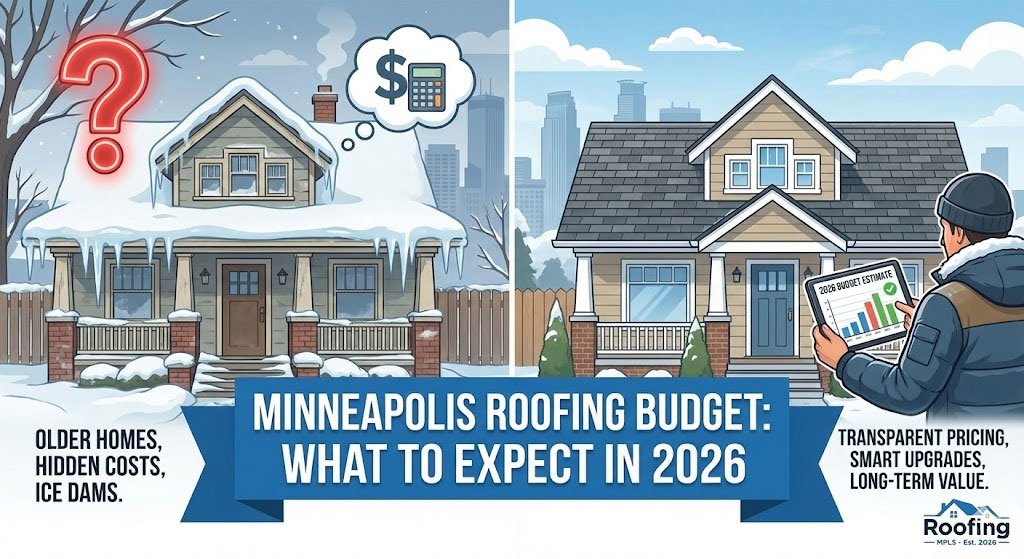
If you are a homeowner in Minneapolis—whether you are in a bungalow in Northeast, a stucco home in Linden Hills, or a fixer-upper in Powderhorn—you know that maintaining a home in the city comes with a unique set of financial demands.
As we move deeper into 2026, the construction market has shifted. The volatility we saw in material prices a few years ago has somewhat stabilized, but labor markets and insurance requirements have tightened. For many Minneapolis homeowners, a roof replacement is the single largest capital improvement they will make this decade.
The question isn’t just “How much does a roof cost?” The real question is: “How do I build a realistic budget that covers the unique requirements of Minneapolis city code and climate?”
In this guide, we will break down the cost drivers for 2026 so you aren’t caught off guard.
Setting the Baseline: The “Square” Cost
In the roofing industry, we don’t price by the hour; we price by the “square” (a 10ft x 10ft area, or 100 square feet).
A standard Minneapolis home typically ranges between 20 to 35 squares. However, the price per square can vary drastically based on the contractor you choose. This is where transparency matters. Before you start collecting quotes, we suggest reviewing independent Minneapolis roofing cost data to understand the current fair market value range. Knowing these numbers helps you spot a quote that is suspiciously low (cutting corners) or predatory (price gouging).
Once you have that baseline in mind, here is where the specific Minneapolis budget factors come into play.
1. The Material Shift: Architectural vs. Impact Resistant
In 2026, the “3-tab” flat shingle is effectively dead. Almost no reputable contractor in Minnesota recommends them anymore because they simply cannot handle our wind ratings.
The standard budget now starts at Architectural Laminate Shingles. These give you that dimensional look and typically come with a solid wind warranty.
However, if you live in a tree-heavy neighborhood (like near Minnehaha Creek) or want to future-proof your budget, you might want to consider Class 4 Impact Resistant Shingles.
- The Cost: They cost about 20-30% more upfront than standard architectural shingles.
- The Savings: Many insurance companies in Minnesota now offer substantial premium discounts for Class 4 roofs. When building your budget, ask your insurance agent about this discount. Over 10 years, the premium savings can often pay for the upgrade.
2. The “Old Minneapolis” Decking Factor
This is the biggest “hidden cost” that surprises homeowners in Minneapolis proper.
Most homes in Minneapolis were built before 1950. Originally, these homes used 1×8 or 1×6 wood planks (spaced decking) for the roof deck. Over 80+ years, this wood dries out, cracks, or rots.
Modern building code requires a solid nailing surface. If we tear off your old shingles and find that the original wood planks are spaced too far apart (more than an inch) or are crumbling, we legally cannot nail new shingles to them. We must install a new layer of OSB (Oriented Strand Board) sheathing over the entire roof.
- Budget Impact: If your home needs re-sheathing, it can add $1,500 to $3,000+ to the project depending on the size of the roof and lumber prices at the time.
- Advice: Always keep a contingency fund of roughly 10-15% of your total bid for “unforeseen decking repairs.”
3. City Logistics: Dumpsters and Permits
Operating in Minneapolis is more expensive than operating in a rural township, and those costs are reflected in the bid.
- Permit Fees: Minneapolis permit fees are calculated based on the value of the job.1 They are non-negotiable and strictly enforced.
- Right-of-Way Permits: If you have a narrow driveway (or no driveway) and we need to place a dumpster on the street, we must pay for a Right-of-Way obstruction permit.
- Alley Access: Many Minneapolis homes rely on alley access. If the alley is too tight for a standard roll-off truck, we may have to use smaller dumpsters (requiring more trips) or specialized equipment to ferry materials from the street to the house. These logistical hurdles add labor hours to the final invoice.
4. Ventilation and Insulation Upgrades
In 2026, energy efficiency is a major focus. When we replace a roof, we aren’t just looking at the water barrier; we are looking at the airflow.
Many older Minneapolis homes suffer from the “hot attic” syndrome, leading to massive ice dams in February. If your current roof has ice dam issues, simply replacing the shingles won’t fix it. You likely need:
- Intake Ventilation: Cutting in new soffit vents or installing “Smart Vents” under the shingles.
- Exhaust Upgrades: Replacing old “turtle vents” with a continuous Ridge Vent system.
While these are technically “optional” in some cases, skipping them is a bad financial move. A budget roof without ventilation will cook the shingles in the summer (voiding the warranty) and freeze the eaves in the winter.
5. Retail vs. Insurance Claims
Finally, how you pay depends on why you are replacing the roof.
The Retail Budget:
If your roof is just old (worn out from age), this is a “retail” job. You pay out of pocket. In this scenario, we can work with you to choose materials that fit your specific financial limit. Financing options are also available to spread the cost over monthly payments.2
The Insurance Claim:
If your roof was hit by hail (common in our area), the “budget” works differently. Your only out-of-pocket cost should be your deductible.
- Warning: If a contractor says they can “waive” or “eat” your deductible, run away. This is insurance fraud and is illegal in Minnesota.
- In an insurance claim, the scope of work is determined by the adjuster. Our job is to advocate for you to ensure the adjuster includes everything required by Minneapolis code (like ice and water shield code upgrades) so you aren’t left paying the difference.
Summary: invest in the System, Not Just the Shingle
In 2026, a roof is a “system.” It includes the deck, the underlayment, the ventilation, the flashing, and the shingles. Skimping on one part of the system to lower the budget usually results in failure within 5 to 7 years.
At Roofing MPLS, we believe in “No Surprise” pricing. We assess your ventilation and decking situation before you sign, so the price we quote is the price you pay.
Need a 2026 Budget Estimate?
If you are planning a project for this season, call us at +1 612-246-7079. We are happy to provide a free, detailed inspection and a clear breakdown of costs for your specific property.
Roofing MPLS is located at 281 Huron Ave, Mahtomedi, MN 55115. We serve the entire Twin Cities metro area, specializing in long-lasting exterior solutions.