
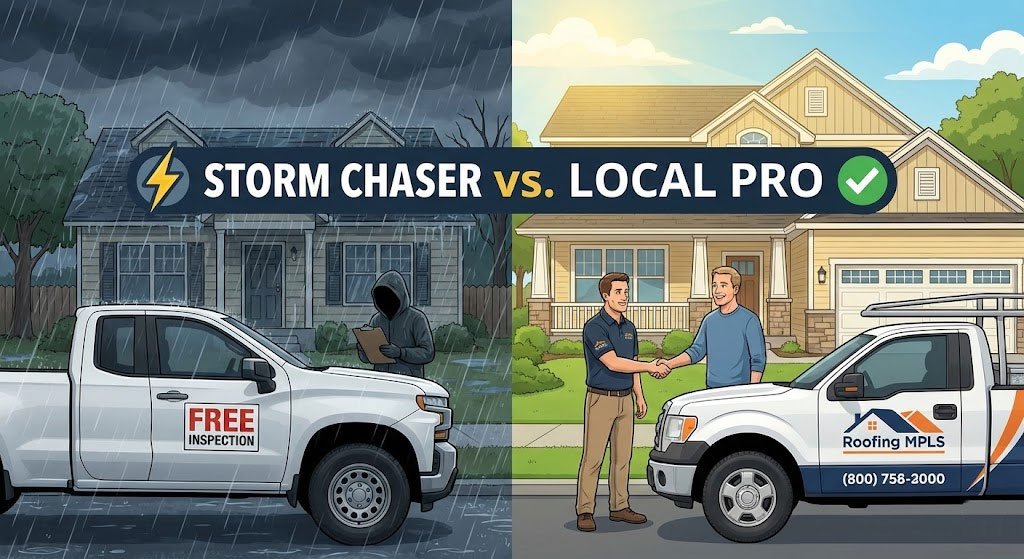
It happens every year. The sky turns green, the sirens wail, and hail the size of golf balls pummels Washington County.
The next morning, the storm clears, but a new wave arrives: trucks with out-of-state license plates slowly cruising through Mahtomedi, Dellwood, and White Bear Lake. Men with clipboards start knocking on doors, offering “free” inspections and promising to handle your entire insurance claim for you.
These are Storm Chasers. While not all of them are necessarily “scammers,” many operate with a business model that puts you, the homeowner, at serious risk.1
If your home has been hit by a storm, do not panic. You have plenty of time to file a claim. Before you let anyone climb your ladder, here is how to distinguish a legitimate local professional from a storm chaser.
The #1 Rule: Verify Before You Trust
Storm chasers rely on urgency.2 They want you to sign a “contingency agreement” immediately, often before you even know if you have damage. They count on you not checking their background.
Don’t just take their word for it. Always use a national database to verify contractor reliability and check their insurance status before signing any paperwork. A legitimate company will have a digital footprint that matches their claims—a physical address, a valid license history, and a track record of verified reviews.
The “Deductible” Trap (It is Illegal!)
The easiest way to spot a dishonest contractor in Minnesota is to listen for the “Magic Words”:
“We can get your roof done for free. We’ll find a way to waive your deductible.”
Stop right there.
In Minnesota, under Statute 325E.66, it is explicitly illegal for a contractor to pay, waive, rebate, or discount your insurance deductible.3
- If a contractor offers to “eat” your deductible by inflating the bid to the insurance company, they are asking you to participate in insurance fraud.4
- If they are willing to cheat the insurance company, do you think they will be honest about the quality of shingles they nail to your roof?
A local, ethical contractor will be upfront: The deductible is your responsibility. We help you get every penny you are owed for the damage, but we do not break the law to get the job.
Check the License Number (IR vs. QR)
Minnesota has strict licensing requirements, but storm chasers often try to skirt them.5 Look closely at the license number on their truck or business card.
- “IR” Number: This stands for “Independent Registered.” It is NOT a contractor’s license.6 It is a simple registration often used by handymen or out-of-state workers who have not passed the Minnesota state competency exam.
- “QR”, “QB”, or “BC” Number: A legitimate roofer should have a license number starting with QB (Qualifying Builder), QC (Qualifying Remodeler), or QR (Qualifying Roofer).7 This means they have passed the state exams and carry the required liability insurance.
Ask to see their pocket license. If they can’t produce it, or if they only have an “IR” number, tell them to leave.
The “Tail Light” Warranty
The biggest risk with storm chasers isn’t just fraud—it’s the lack of accountability.
These crews are often “nomadic.”8 They flood into the Twin Cities after a storm, sub-contract the work to the lowest bidder, collect the insurance checks, and then move on to the next storm in Oklahoma or Texas.
When your roof starts leaking 18 months later because the flashing was installed incorrectly, you call their number.
- The line is disconnected.
- The “local office” was just a temporary PO Box or a rented Regus suite.9
This is what we call the “Tail Light Warranty”: The warranty expires the moment you see their tail lights disappear down the street.
Why “Local” Actually Matters
Hiring a contractor with a physical office in your community—like our office at 281 Huron Ave—is your ultimate safety net.
- We are here next year: If a shingle blows off in a winter blizzard, you know exactly where to find us.
- Reputation is everything: We don’t survive on “one-and-done” storm jobs. We survive because our neighbors in Mahtomedi recommend us to their friends.
- Local Knowledge: We know that Washington County inspectors are strict about ice and water shield code upgrades. Out-of-state crews often miss these local code nuances, leading to failed inspections and delays.
Conclusion: Slow Down
If you have hail damage, your roof isn’t going to collapse tomorrow. You have one to two years to file a claim with most insurance carriers.
- Don’t sign a contract on the doorstep.
- Don’t be bullied by high-pressure tactics.
- Do verify their license and physical address.
If you want an honest assessment from a team that lives and works right here in the Twin Cities, call Roofing MPLS at +1 612-246-7079. We will give you the truth about your roof, not a sales pitch.
Roofing MPLS: Serving Mahtomedi and the Greater Twin Cities with honesty, integrity, and Minnesota-tough roofing solutions.