
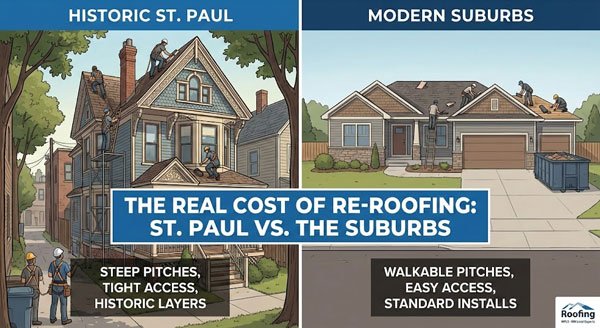
If you own a home in the Twin Cities, you know that the housing landscape is incredibly diverse. We have the stately, historic Victorians of Summit Avenue in St. Paul, and just fifteen minutes away, we have the spacious, modern ranches of Mahtomedi and Woodbury.
At Roofing MPLS, one of the most common questions we get is: “My brother in the suburbs paid $X for his roof; why is my quote for a similar-sized home in the city so different?”
It is a valid question. The reality is that geography, architecture, and city ordinances play a massive role in the final price tag of a roof replacement. Re-roofing a historic home in St. Paul is often a completely different logistical beast than re-roofing a home in the outer suburbs.
In this guide, we will break down exactly why these costs differ and what you need to budget for.
The Baseline: Understanding Market Rates
Before we dive into the complexities of steep slopes and tight alleys, it is important to understand the baseline financial landscape. Roofing material costs (asphalt, nails, underlayment) are generally consistent across the metro area. Whether you are in Ramsey County or Washington County, a bundle of GAF Timberline shingles costs roughly the same.
However, labor and “complexity factors” vary wildly. Before budgeting for your renovation, we highly recommend checking the current St. Paul roofing cost averages to see how your specific neighborhood compares to the state baseline. This data will give you a realistic starting point before we factor in the unique challenges of your property.
Factor 1: Roof Pitch and Walkability
The single biggest differentiator between a St. Paul home and a suburban home is often the “pitch” (steepness) of the roof.
The Suburban Scenario:
In suburbs like Mahtomedi, Oakdale, or Maplewood, many homes built from the 1970s onward have “walkable” roofs. These are typically 4/12 to 6/12 pitches. Our crews can walk on these surfaces safely without extensive staging. This allows for faster tear-off and installation, which keeps labor costs lower.
The St. Paul Scenario:
St. Paul is famous for its pre-WWII architecture—Tudors, Victorians, and Colonials. These homes often feature 10/12 or 12/12 pitches.
- Safety Equipment: A roof this steep cannot be walked on. It requires harnesses, toe-boards, and sometimes full scaffolding.
- Slower Pace: Every bundle of shingles must be manually carried or hoisted with extra care. Tear-off takes twice as long because debris doesn’t just slide into a dumpster; it must be managed carefully to avoid hitting the house or neighbors.
If you have a steep roof in the Highland Park or Mac-Groveland neighborhoods, expect labor costs to be 20% to 40% higher than a standard suburban ranch simply due to the difficulty and danger involved in the install.
Factor 2: The “Tear-Off” Surprise (Layers of History)
When we tear off a roof in a newer suburb, we usually find one layer of old asphalt shingles over a solid plywood deck. It is a predictable, clean job.
In St. Paul, however, we are often unearthing history. It is not uncommon to find:
- A layer of asphalt shingles.
- A second layer of asphalt shingles underneath.
- The Deal Breaker: Original cedar shakes at the very bottom.
Many older homes in Minnesota were originally roofed with cedar shakes. Decades ago, roofers would often just nail asphalt shingles right on top of the cedar to save money. Today, building codes require us to strip everything down to the deck.
Stripping cedar shakes is incredibly messy and labor-intensive. furthermore, cedar shakes were often installed on “skip sheathing” (spaced out wood planks) rather than solid plywood. Modern asphalt shingles require a solid surface. This means if we find cedar, we almost always have to re-sheet the entire roof with new OSB or plywood. This can instantly add thousands of dollars to a project—a cost that rarely exists for homes built after 1980.
Factor 3: Accessibility and The “City Squeeze”
Construction is a game of logistics. How close can we get the materials to the roof?
Suburban Access:
In Mahtomedi, we typically have a wide concrete driveway. We can park our dump trailer right next to the house. Our suppliers can use a “boom truck” to lift pallets of shingles directly onto the roof ridge. Efficiency is high.
St. Paul Access:
In the city, we are often dealing with:
- Narrow Alleys: Many St. Paul homes are accessed via alleys that are too narrow for large supply trucks.
- Street Parking: If we have to park the dumpster on the street, we need city permits, and we have to hand-carry debris from the backyard to the street.
- Power Lines: Overhead power lines in older neighborhoods often prevent boom trucks from operating. This means materials may need to be hauled up ladders by hand or by a motorized ladder lift.
These logistical hurdles add man-hours to the job. While the roof size might be the same as a house in the suburbs, the time it takes to move materials on and off the roof can double.
Factor 4: Ice Dams and Ventilation
Minnesota winters are brutal, but they affect city homes and suburban homes differently regarding ventilation.
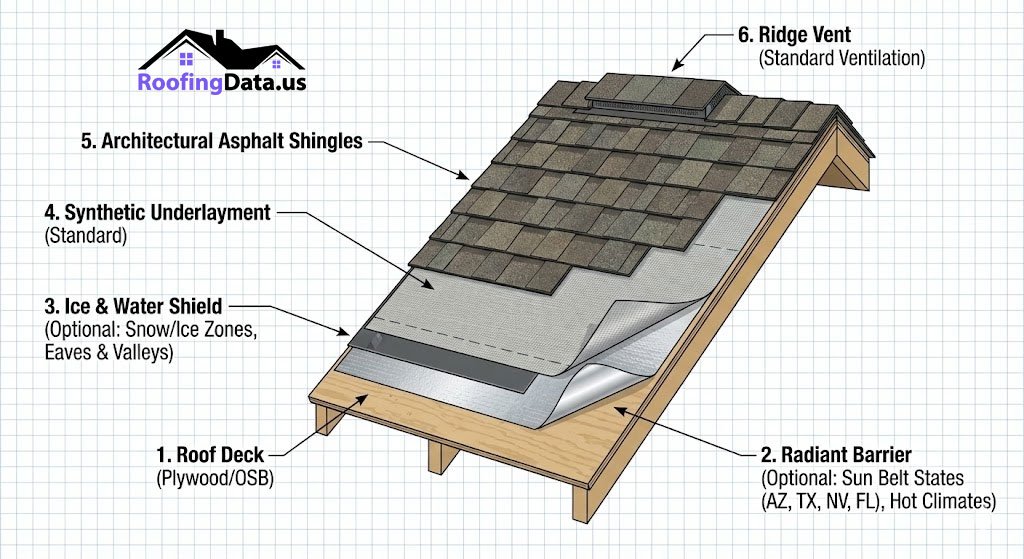
Modern suburban homes usually have engineered soffit and ridge vents that create a perfect airflow cycle, keeping the roof cold and preventing ice dams.
Older St. Paul homes were often built without any soffit overhangs. This makes achieving proper intake ventilation very difficult. To prevent ice dams on these homes, we often have to install:
- Smart Vents or Edge Vents: Specialized intake vents that sit under the shingles near the gutter.
- Extra Ice & Water Shield: Minnesota code requires ice and water shield (a rubberized waterproof membrane) on the eaves. On older homes with a history of ice dams, we often recommend upgrading to cover a larger percentage of the roof deck, or even the entire roof, for maximum protection.
These upgrades are critical for protecting the interior of a historic home, but they do add to the material cost compared to a straightforward suburban install.
Factor 5: Permitting and Heritage Preservation
Finally, there is the paperwork.
- Standard Permits: Every city requires a permit, but fees vary. St. Paul and Minneapolis permit fees can sometimes be higher than outlying townships.
- Heritage Preservation Sites: If your home is in a designated St. Paul Heritage Preservation District (like parts of Summit Hill), we cannot just slap on any shingle. We may need to use specific materials that mimic the original look (like slate-look composite or architectural asphalt) to get approval from the heritage board. This often restricts us to premium product lines, which naturally carry a higher price tag.
Conclusion: Value over Price
Whether you are in a 1920s bungalow in St. Paul or a 1990s build in Mahtomedi, the goal is the same: a watertight roof that can handle Minnesota’s extreme freeze-thaw cycle.
While the upfront cost of re-roofing in the city is often higher, it is an investment in preserving a unique piece of architecture. At Roofing MPLS, we have the specialized equipment to handle steep pitches and the experience to navigate historic renovations carefully.
Ready to get an accurate number?
Don’t guess based on your neighbor’s project. Call us today at +1 612-246-7079. We will come out to your property (whether it’s on a tight city street or a cul-de-sac), inspect your decking and ventilation, and give you an honest, transparent estimate.
Located at 281 Huron Ave, Mahtomedi, MN 55115, Roofing MPLS is your local expert for storm damage and exterior renovation.